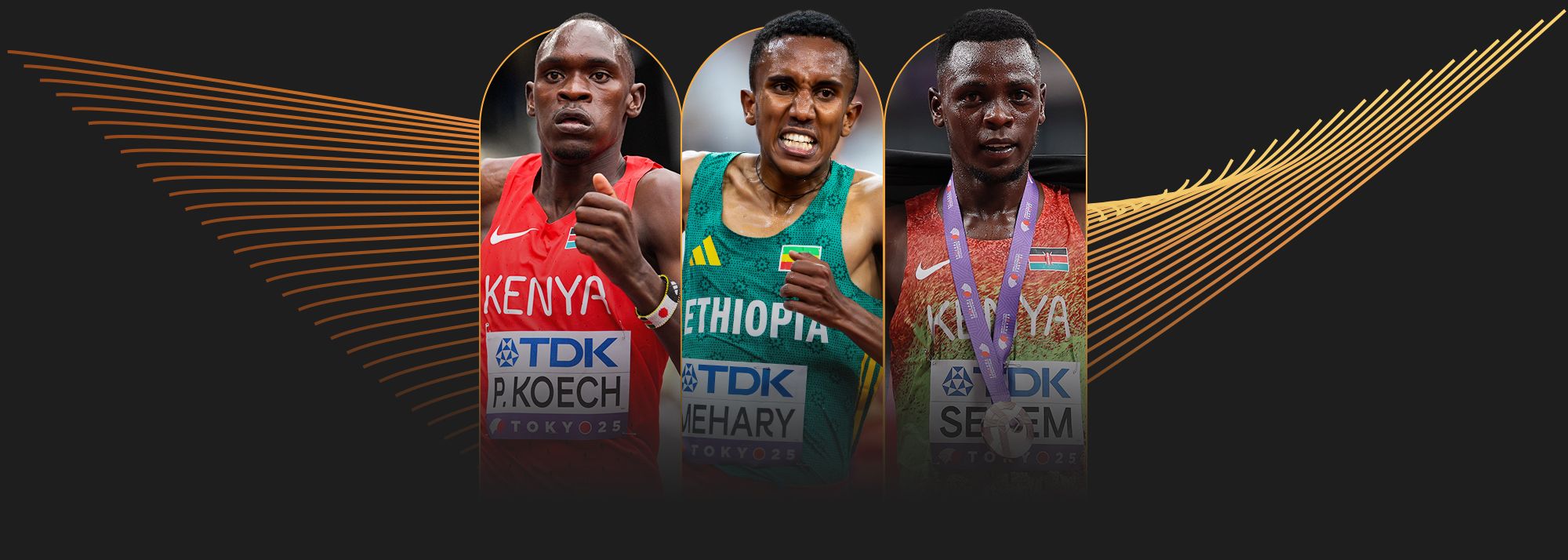
World Athletics has announced the three finalists for the 2025 Men’s Rising Star Award — and Kenyans dominate the shortlist, with two of the three nominees.
The award, which honors the year’s best u-20 athlete, will be presented at the World Athletics Awards on 30 November.
This year’s nominations recognize some of the sport’s most exciting young talents, following standout performances across major global competitions, including the World Athletics Championships Tokyo 25.
Leading the Kenyan charge is Phanuel Koech, who made history earlier this season by breaking the world u-20 1500m record.
Few had heard of Koech prior to the Wanda Diamond League meeting in Paris two months ago. But the Kenyan teenager, in what was just his second 1500m race, catapulted himself into the sport’s consciousness by finishing second in a highly competitive field, breaking the u-20 record with 3:27.72.
His time also propelled him to ninth on the senior world all-time list, bumping Olympic bronze medalist Yared Nuguse out of the top 10. The world record (3:26.00) is held by Morocco’s Hicham El Guerrouj from 1998.
One month later in London, in Koech’s next Diamond League appearance, he won in 3:28.82 and beat world champion Josh Kerr, among others.
When asked which performance he values most – the world U20 record or a Diamond League victory – he said the latter.
“I am looking ahead; I am no longer focusing on the u-20 category,” he said.
“While I value the world record I ran in Paris, which will stay in the history books as a great moment in my career, beating Josh Kerr at the London Diamond League was a greater moment for me as it shows the potential I have and that I am now able to compete against senior athletes.”
In between his races in Paris and London, Koech also won at the Continental Tour Gold meeting in Ostrava, clocking 3:29.05. He now owns three of the four fastest 1500m times by an u-20 athlete, but he insists he has never focused on chasing specific times or records.
His goal for London, in fact, was to win as he’d been told it would act as his trials for the World Championships in Tokyo. His Paris outing, meanwhile, was more about gaining valuable experience.
“Running my first Diamond League race in Paris, I had no experience but believed I had the potential,” said the 19-year-old. “I wanted to see what would happen if I reached the 300m mark with the leading contenders.
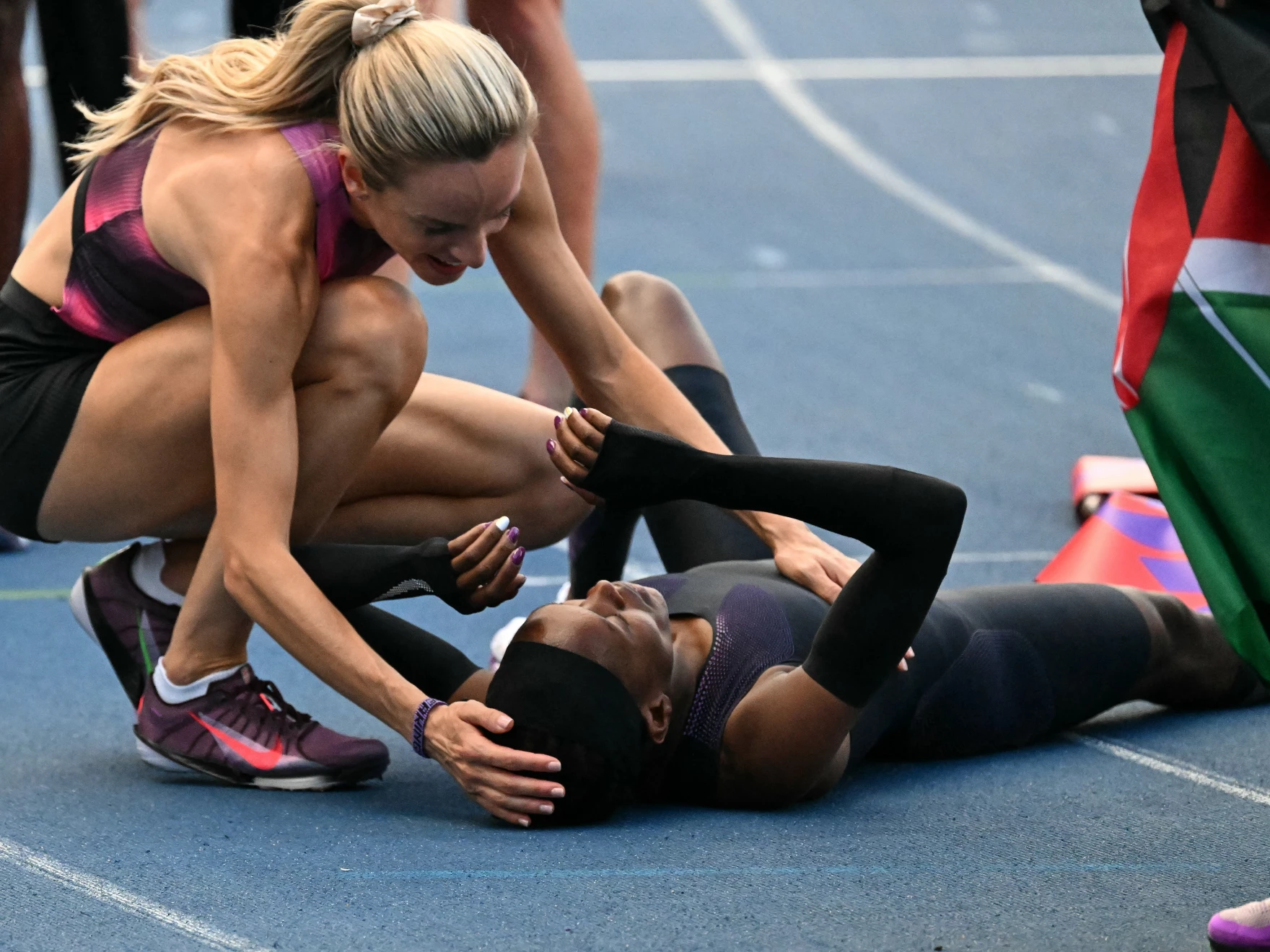
At the Tokyo World Championships, Koech fell during Heat 4 of the first round and finished 12th, thus being eliminated from advancing to the semi-final. The top six athletes in each heat advance to the semis.
In a video shared online, Sweden’s Samuel Pihlström appeared to give Koech a slight nudge on the back, causing him to trip and tumble to the ground.
Kenya appealed for the 18-year-old to advance to the semi-final, but the appeal was rejected.
He is joined by compatriot Edmund Serem, who impressed on the world stage with a bronze medal in the 3,000m steeplechase at the Tokyo World Championships. Serem capped off his season with a strong runner-up finish at the Diamond League final.
Serem competed in the 3000m steeplechase at the 2025 Xiamen Diamond League event in China, in April 2025, running a personal best time of 8:08.50. The following weekend, he secured second place in the 3000m steeplechase at the 2025 Shanghai Diamond League, running a time of 8:08.68.
In May 2025, he ran a new personal best of 8:07.47 to finish third in the 3000m steeplechase at the 2025 Meeting International Mohammed VI d’Athlétisme de Rabat, also part of the 2025 Diamond League, and followed that with a steeplechase win at the Kip Keino Classic in Nairobi on 31 May, 2025.
Ethiopia’s Biniam Mehary completes the trio of finalists. The teenager set a world u-20 record over 3000m on the short track and finished fifth in the 5000m at the World Championships, marking him as one of Africa’s most promising long-distance runners.
The dominance of Kenyan athletes in this year’s shortlist highlights the nation’s ongoing success in nurturing world-class young talent. Koech and Serem will be strong contenders to follow in the footsteps of past Rising Star winners who have gone on to achieve senior global titles.
The Women’s Rising Star Award finalists will be announced tomorrow.
Alongside the Rising Star categories, the 2025 World Athletics Awards will also celebrate achievements across the sport with honours including World Athlete of the Year, Coaching Achievement Award, Woman of the Year, Photograph of the Year, Member Federation Award and the President’s Award.
On 4 November 2025, World Athletics released the final two names in the running for Female Track Athlete of the Year: Sydney McLaughlin-Levrone and Femke Bol. Two phenomenal athletes, without question. But for many athletics fanatics, the announcement felt less like celebration and more like a provocation.
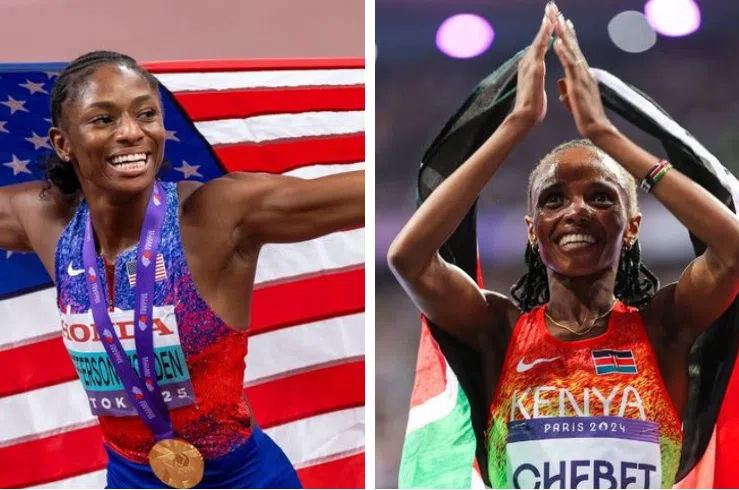
How did runners such as Faith Kipyegon or Beatrice Chebet or Melissa Jefferson-Wooden — after seasons of record-breaking dominance — get left waiting at the door?
The Case for McLaughlin-Levrone and Bol
There is no denying that both finalists earned their place on merit.
McLaughlin-Levrone stunned the athletics world by switching from her familiar hurdles discipline into the flat 400m and running 47.78 seconds to win gold at the Tokyo World Championships. A championship record, the fastest women’s 400m in 40 years and second on the all-time list. That is not a footnote. It is a landmark.
Bol’s dossier is equally sharp: unbeaten for much of the season, she successfully defended her world 400m-hurdles crown in Tokyo in a world-leading 51.54, capping a torrid run of Diamond League dominance and a European Athlete of the Year title.
From a technical standpoint this makes sense: two athletes at the very peak of their form, each in a one-lap event, with clear championship narratives.
The snub that hurt: what the excluded did this year
But this is not just about who is on the shortlist. It is almost more about who isn’t. And that is what has stirred the athletics community.
Take Melissa Jefferson-Wooden: at the World Championships she did something almost cinematic — the sprint double (100m & 200m) and a 4×100m gold — posting a championship record 10.61 in the 100 and a world-leading 21.68 in the 200. By achieving this “sprint triple”, Jefferson became the first American woman to do so and only the second woman ever after Jamaica’s sprint sensation Shelly-Ann Fraser Pryce.
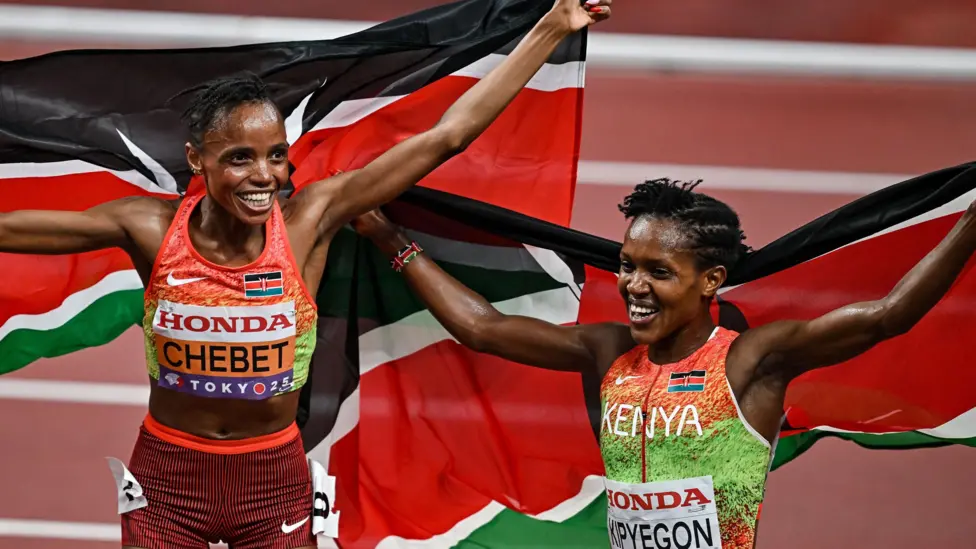
Then Kenya’s own: Faith Kipyegon rewrote the 1,500m conversation, lowering her own world record to 3:48.68 and defending her world 1500m title making it four in row— feats that keep her in the same breath as the event’s immortals.
Beatrice Chebet ran down records in the 5,000m and 3,000m. Chebet broke the 5000m World Record at the Prefontaine Classic in Eugene, clocking an astonishing 13:58.06 to take 2.15 seconds off the previous record of 14:00.21 and become the first woman in history to break the 14-minute barrier.
The long-distance queen then completed another 5000m and 10,000m gold medal double at the World Championships in Tokyo (mirroring her 2024 Olympic double). Despite her historic feats, she was snubbed again from being a finalist for the award.
That anger also had a local colour. Kenyan outlets and columnists framed the omissions as an affront not only to individual athletes but to a tradition — to Kenya’s modern identity as a distance powerhouse. Online commentators used words like “snub,” “scam,” and even questioned fairness and representation. Those are heavy words, and they point to something that’s as much cultural as it is statistical: awards don’t only hand out trophies, they write histories.
Global Voices Echo the Frustration
The outrage is not limited to Kenyan social media feeds. On X, LetsRun.com’s Jonathan Gault wrote bluntly:
“Athlete of Year over Melissa Jefferson-Wooden and Beatrice Chebet is legitimately insane.” X (formerly Twitter)
Meanwhile, Chris Chavez — founder of CITIUS Magazine — flagged the omission more neutrally but firmly: he reminded followers that Chebet and Kipyegon were among the nominees but did not make the final cut. X (formerly Twitter)
While neither made long commentary threads, their tone echoes the same concern: when the final shortlist bypasses athletes whose seasons were historically great, questions about the transparency and fairness of the process gain legitimacy.
What Does This Mean for Kenya & for World Athletics?
For Kenyan athletics, this is a moment of reflection more than protest. It is proof that performance on the track does not always translate into recognition if it does not align with how committees perceive value.
Athletics Kenya, fan groups, and media commentators may push for greater clarity in how finalists are selected — especially given that the public vote component (via social media) appeared to favour Kenyan athletes more strongly than the final result.
It’s not just about Kipyegon or Chebet personally. It is about what “global recognition” means for a distance-running powerhouse whose champions have often carried Kenya’s identity on the world stage.
If Kenya hopes to see more of its athletes consistently featured in global award finals, then its voice must adapt — not just through podiums and records, but through engagement with the narratives and systems that award bodies use.
How finalists are chosen — and why outrage makes sense
World Athletics doesn’t simply put the loudest social posts on stage. Their published method splits voting among the World Athletics Council (50%), the World Athletics Family (25%), and social media votes (25%) to create the first-round finalists. After that, fans on WorldAthletics+ help determine the final overall athlete. That weighting matters: it explains how an athlete extremely popular with fans could still be left out if the Council and family votes skew elsewhere.
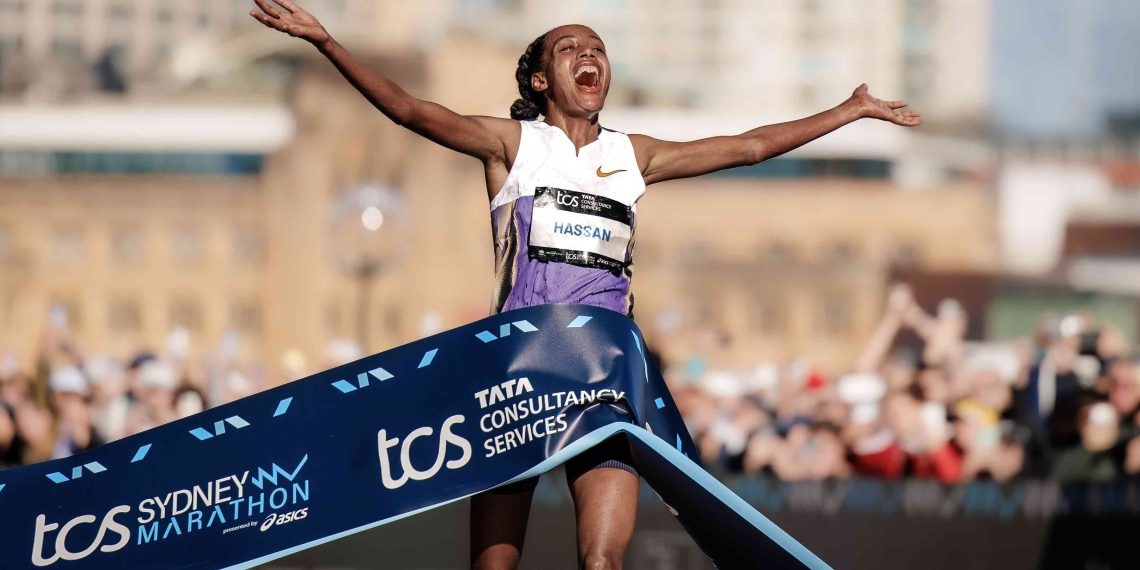
Fresh off a record-breaking run in Sydney, Dutch star Sifan Hassan stands on the brink of yet another monumental test — her debut at the New York City Marathon, taking place today (Sunday) at 3:35 p.m. Kenyan time.
The reigning Olympic marathon champion has been one of the sport’s most fascinating figures, blending brilliance with humility and raw honesty. As she prepares to tackle the world’s most iconic 42km course, Hassan has opened up about her mindset, her fears, and her respect for the formidable field awaiting her in New York.
“I’m excited, but also nervous,” Hassan admitted in an interview with Dutch broadcaster NOS. “The field is full of very strong women — especially the Kenyans. I’m afraid of them, to be honest. Sharon Lokedi, Hellen Obiri, Sheila Chepkirui — they all know this course, they’re used to racing here. For me, it’s my first time. It’s going to be hard.”
Her words may sound modest, but her record speaks of dominance. Since making her marathon debut in London 2023, Hassan has run six races over the distance and won four. In Paris 2024, she stormed to Olympic gold in 2:22:25 — an Olympic record — adding to her collection of bronze medals in the 5,000m and 10,000m. Her latest performance in Sydney 2025 broke the Australian all-comers record with a time of 2:18:22, the fastest ever on the continent.
Calm Amid the Chaos
Despite her credentials, Hassan insists she is not burdened by expectation. “I can win, but I’m not going to let that get to me,” the 32-year-old said. “I can’t just think about winning — there’s no point. I prefer to play it smart. Of course, I want to win, but I don’t need that extra pressure.”
This approach reflects a maturity that defines her journey from a refugee in the Netherlands to one of the most versatile runners in modern athletics. She has learned to thrive without the weight of perfection.
“The marathon is more than just the race itself; it’s all the preparation — the training, the recovery, the mental work,” she explained. “Every marathon is different. This course is new to me, and I respect it.”
Indeed, New York’s five-borough course is notoriously challenging — full of turns, bridges, and rolling hills that punish even the most seasoned runners. “They say it’s the best,” she smiled, “but I hope it’s not the toughest.”
Fear of the Kenyans
Her candid admission of “being afraid” of her Kenyan rivals has drawn attention, not because it signals weakness, but because it captures the psychological reality of elite sport.
In the women’s field, the last three New York champions are all Kenyan: Sharon Lokedi (2022), Hellen Obiri (2023), and Sheila Chepkirui (2024). Each brings experience, grit, and tactical knowledge of the course that Hassan lacks.
“They’re strong, mentally and physically,” Hassan said. “When you see them run, they don’t give up. You have to fight every second with them. I respect that — it pushes me to be better.”
Hassan’s comments reflect a healthy tension between admiration and competition. It’s the same energy that has often driven her to her best performances.
Skipping Worlds for Sydney — and Success
While most of her rivals spent August competing at the World Athletics Championships in Tokyo, Hassan made a bold decision to skip the event and focus entirely on Sydney. Critics questioned her choice, but the result silenced any doubts — she delivered a masterclass, breaking the Australian record and dominating the field.
It was a gamble rooted in self-awareness. “I knew what my body needed,” she said. “Sometimes you have to choose your battles.”
“I feel like I hate myself or something. When I was practicing, it really freaking hurt!” she added. You may hate yourself for running two World Majors in 64 days.
Now, after Sydney’s triumph, Hassan says she feels fresh and mentally clear for New York — even if the course remains a mystery.
Speaking Out on Doping and Ruth Chepng’etich’s Ban
Away from racing, Hassan also addressed the recent doping ban of Kenyan marathoner Ruth Chepng’etich, who is serving a three-year suspension after testing positive for Hydrochlorothiazide, a prohibited diuretic.
“It’s really sad,” Hassan said in an interview with LetsRun.com. “It’s hard for me to say anything about other athletes. I don’t know what to say — it’s just very hard. I believe that’s for WADA to handle.”
Hassan revealed that she only learned about the ban recently, having deliberately stayed off media to concentrate on her training terming the race “very hard with strong female racers”.
The Dutch star used the moment to reflect on the wider problem of doping in athletics. “Many athletes make mistakes because they don’t have enough education,” she said. “You can run fast for a while, but you can also destroy your life. Once you start using substances, your body becomes dependent. It’s dangerous. Some retire early; some face health problems. It’s really sad.”
She added that athletes should be taught the consequences early in their careers. “They should learn how dangerous it is. You might win now, but you won’t last long. It’s better to work harder, and you’ll have a career of ten years or more. That’s what I want to teach the young generation.”
The Marathon of Mind and Spirit
For Hassan, the marathon remains a mirror of life — unpredictable, punishing, but profoundly rewarding.
“I always say, you never know what’s going to happen,” she said. “You can prepare for months, but on race day, anything can change. That’s what makes it beautiful — it’s not just about running; it’s about surviving.”
Today in New York, she faces not only the course and her competitors but her own doubts — and perhaps that’s where her strength lies.
Her honesty, humility, and resilience make her one of the most relatable figures in modern sport. Whether she wins or not, Hassan’s story continues to embody the spirit of running: courage, perseverance, and the relentless pursuit of better.
And as the clock ticks toward the 3:35 p.m. start in Kenya, all eyes will be on the streets of New York — where Sifan Hassan will once again test the limits of her body and the power of her belief.
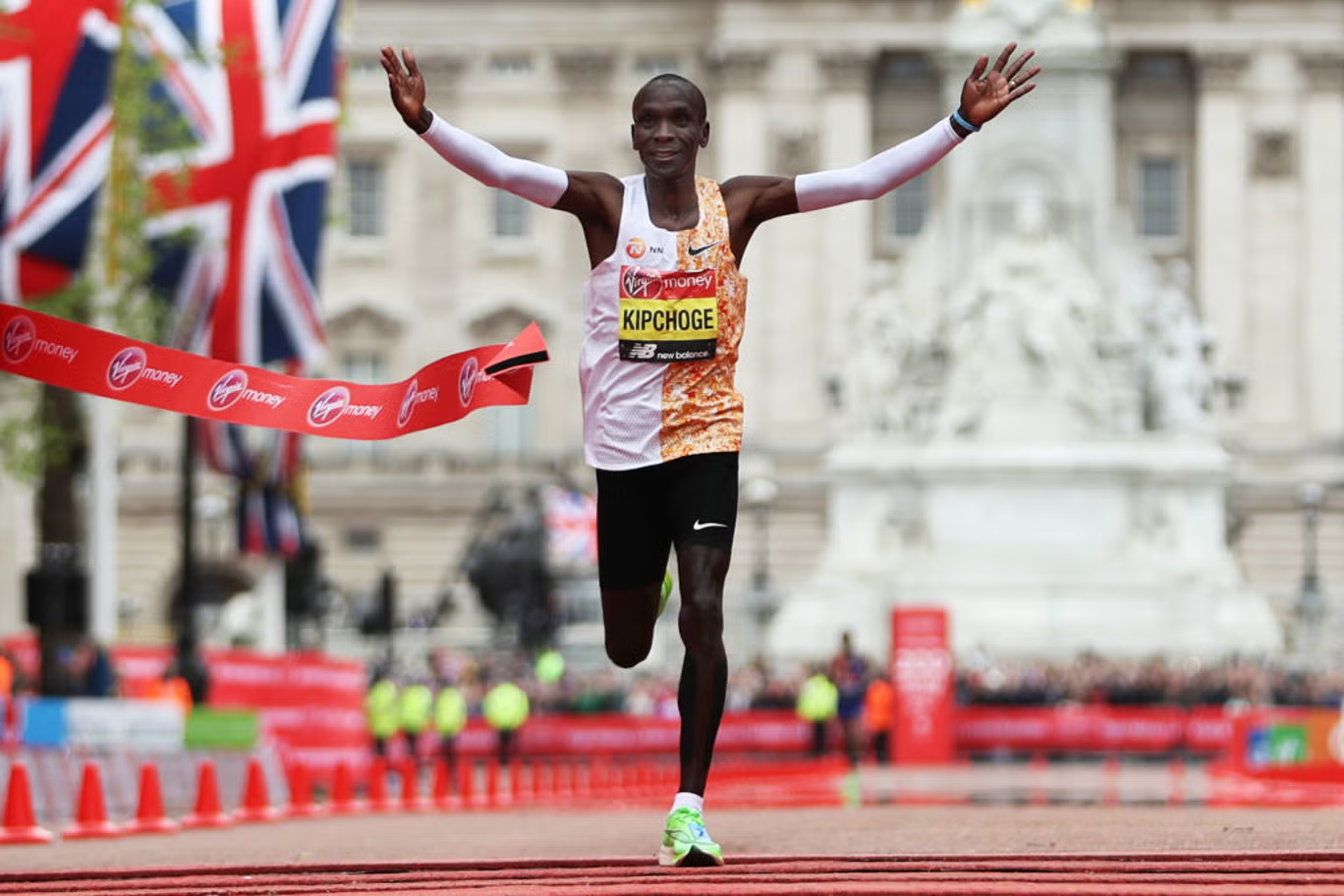
When Eliud Kipchoge steps onto the starting line of the 2025 New York City Marathon, the world will pause to watch a legend in motion — perhaps for the last time.
At 40 years old, turning 41 next week the Kenyan great has hinted that this could be his final elite marathon, marking the end of a glittering 13-year career on the roads that includes 16 wins from 23 competitive marathons. For context, 11 of those wins have been at marathon majors, making him the most decorated athlete-male or female in the history of marathon majors.
“November, and it’s New York…It’s a place that has been on my mind for a long time,” Kipchoge told Olympics.com. “It’s time for me to go there and get a Seven Star before embarking on my new journey of running for other things—running for a purpose.”
The Seven Star Hall of Fame honors the runners who have completed the marked World Marathon Majors – Tokyo, Boston, London, Sydney, Berlin, Chicago, and New York City.
Kipchoge’s most successful Major destination to date is Berlin, which he has won five times, including two world record times.
But the thrill of new adventures doesn’t end there for the Kenyan, one of only three men to have won two consecutive Olympic marathons besides Ethiopia’s Abebe Bikila (1960 and 1964) and East Germany’s Waldemar Cierpinski (1976 and 1980), who revealed his plans to take on new continents in the future.
“I will run in Antarctica!” he answered assuredly. “I now want to do that extreme thing that can make someone work hard…”
For Kipchoge, who has conquered every challenge from Berlin’s flat speedways to London’s tactical tests, the New York race represents both a farewell and a full circle. It is the only World Marathon Major he has never run — and one that completes his Seven Star dream.
Beyond New York, Kipchoge a 2:01:09 marathoner (his PB), set at the 2022 Berlin Marathonwill not stop as he has more in store for the future: “I will run even 50km in Saudi Arabia.”
Kipchoge last competed at the Sydney Marathon in August, finishing ninth with his last win being the Berlin Marathon where he cut the tape in a time of 2:02:42 two years ago- also his last podium.
A Career Etched in Gold
Kipchoge’s story is one of serene mastery and relentless discipline. From his breakout as a teenage world champion over 5,000m in 2003 to his domination of marathons in the past decade, his record is a catalogue of excellence.
He is a two-time Olympic champion (Rio 2016, Tokyo 2020), a four-time London Marathon winner, and multiple world records including his Berlin lifetime best of 2:01:09 that was later improved by countryman and the late Kelvin Kiptum with his 2:00:35 world record in Chicago in 2024.
And then there was Vienna — the INEOS 1:59 Challenge in 2019 — where he became the first man in history to run a marathon in under two hours. Though not an official world record, it remains a defining symbol of human possibility.
“No human is limited,” he said after that run — a phrase that became his mantra and a global movement of belief.
Kipchoge is content with his career, embracing both the highs and lows. But still has one big regret: “Missing the world record for 5000m”.
His personal best time in the 5000m was 12:46.53, set on 2 July, 2004, at the Golden Gala meeting in Rome, Italy. While this was an exceptionally fast time that made him the sixth-fastest man ever at the distance at the time, it was not a world record. The men’s 5000m world record at the time was held by Kenenisa Bekele with a time of 12:37.35, set on 31 May, 2004.
The current 5000m world record is 12:35.36, set by Joshua Cheptegei on 14 August, 2020. Kipchoge did, however, set a world junior record for the 5000m with a time of 12:52.61 at the 2003 Bislett Games.
At Paris 2024, he failed to finish the Olympic race, and has focused this year on working through that failure and continuing to push his belief in limitless human potential.
Currently, the average marathoner is in their 20s, and there is a large pool of talented runners competing for top honors. But Kipchoge is unperturbed and continues to command respect in the Majors, which speaks volumes of his brilliance.
“To still push at my age is really good, I am showing people that age is just a number,” he said.
Why New York Matters
Unlike the smooth asphalt of Berlin or the open boulevards of Tokyo, New York offers grit: bridges, climbs, and roaring crowds that make it more a battle of will than pace.
For Kipchoge, that’s exactly why it matters.
“Every race has its own story,” he said. “New York is about people, energy, and finishing something bigger than myself.”
Trained by long-time coach Patrick Sang in Kaptagat, Kenya, with the NN Running Team, the father of three (Lynne, Griffin, and Gordon) may be 40 years old now, but he still possesses the same hunger. Nothing less than a top-three finish in his first attempt will do in the Big Apple.
“I’m really ready to run well. I will be trying to be on the podium, [for me] it’s like any other serious, normal race,” he said. “I will fight to run in a good way on the streets of New York. It’s not about just participating, it’s about competition.”
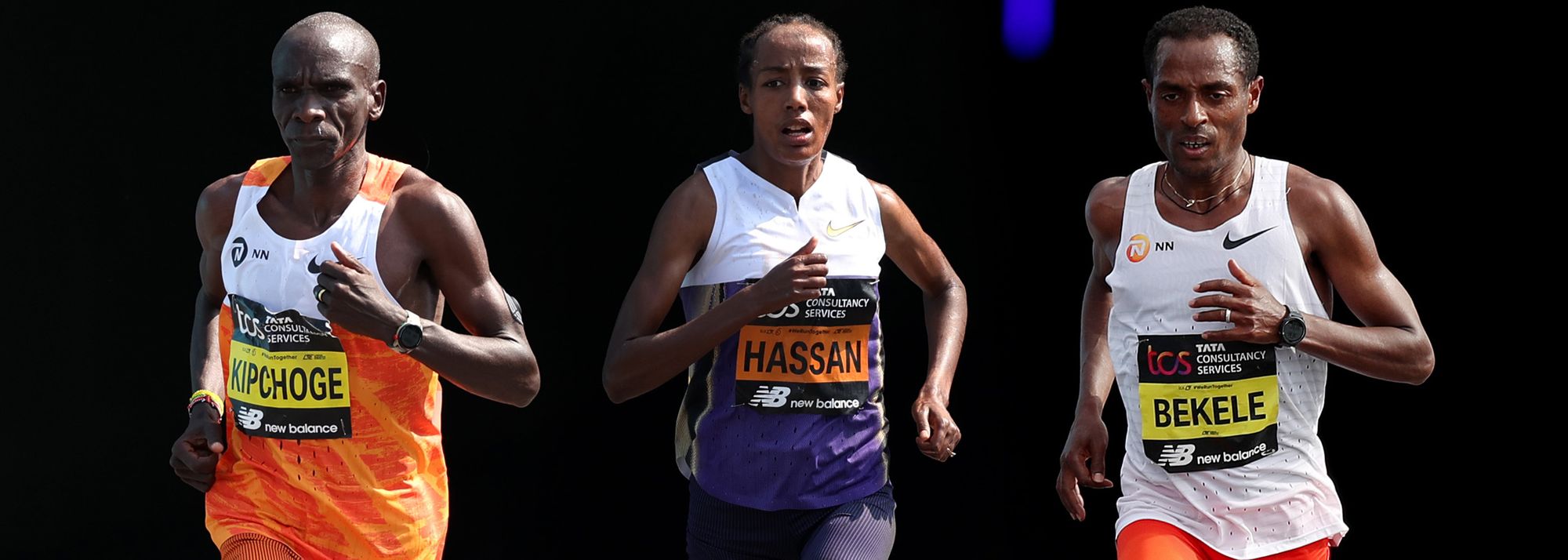
In New York, Kipchoge starts as the fastest man in a field that includes his long-term rival Kenenisa Bekele, as well as former champions Abdi Nageeye and Evans Chebet.
Kipchoge wants to “complete his marathon legacy” before stepping back from elite competition.
“I’ve been training for major marathons for a very long time and I have never completed all of them. If I don’t complete, I feel like I am halfway – I am not a rounded person,” he said. “My legacy will be complete because I will have a sixth star.”
Kipchoge to run three marathons in a season for the first time
It’s a late run in the year for Kipchoge, who typically reduces the volume of his training in the final quarter.
He will face a formidable challenge in New York City, a difficult course renowned for its hills and turns: “It’s up and down, but with two million people lining up the streets, they should somehow help you push. I think it will be a beautiful course,” he continued.“I didn’t have to change my training for this, as I still believe I have the mileage in my muscles after the Sydney marathon. So, it was mainly just changing my mind to accept that I can run three marathons in a year…and then I decided to go for it.
“What I am also aiming for is to show the young people that you can still push limits and do more marathons.”
Kipchoge, the training partner to Faith Kipyegon, opened his season in April finishing sixth in London in a time of 2:05:25. Compatriot Sebastian Sawe emerged vicrorius with a daring move- breaking from the leading park after the 10km mark. He went ahead to win in 2:02:27 beating Uganda’s half-marathon world record holder Jacob Kiplimo to second in 2:03:32. Alexander Mutiso was third.
Kipchoge laments about cheating in athletics
Kipchoge a long-time anti-doping advocate, his lengthy career has also overlapped with a spate of high-profile doping cases in marathon running, particularly from his native Kenya.
Asked about compatriot and world record-holder Ruth Chepngetich, who was handed a provisional suspension in July after testing positive for a prohibited substance, Kipchoge said: “It’s a shame actually for people to break the rule in sport.”
A Farewell Worth Watching
When he takes off from Staten Island on that crisp Sunday morning, Kipchoge won’t just be running for victory. He’ll be running for legacy — for every Kenyan who has laced up a shoe because of his story, and for every dreamer who believes limits can be broken.
Whether he wins or simply finishes, New York will be his victory lap — a celebration of endurance, grace, and humanity.
And when he crosses that finish line in Central Park, one era of marathon running will quietly bow out — leaving footprints too deep for time to erase.
Patrick Sang, the renowned coach behind running greats Faith Kipyegon and Eliud Kipchoge, has opened up about the Breaking4 project — an ambitious attempt to push the limits of human performance and athletic endurance.
In June, Kipyegon set out to become the first woman ever to run a sub-four-minute mile, a barrier long seen as impossible. Already the world record holder with 4:07.64 set in 2023, Kipyegon’s target demanded an extraordinary improvement of more than seven seconds.
Backed by Nike, the attempt featured elite pacemakers, cutting-edge aerodynamics, and custom racing spikes designed to maximize speed. The event took place at the Stade Sébastien Charléty in Paris on 26 June this year.
Kipyegon gave a valiant effort, clocking 4:06.42 — lowering her own world record by over a second but narrowly missing the elusive four-minute mark.
Sang: ‘I Was a Bit Worried for Faith’
Speaking to Citius Mag, Patrick Sang reflected on the project’s successes and shortcomings. He drew parallels between Kipyegon and Kipchoge, noting that both share the same discipline, humility, and deep sense of purpose that has defined their careers.
“Faith and Eliud mirror each other in many ways,” Sang said. “They both value the people around them and draw strength from those who support them.”
Despite minor challenges, Sang described the Breaking4 experience as largely smooth and well-executed. “Not everything was within our control,” he admitted. “But the process flowed naturally from the careful preparation that had gone into it.”
He praised the unity and collective effort behind the project, saying it demonstrated how collaboration can expand human imagination. “It allowed people to think beyond limits — that the human mind and possibilities are elastic,” he said.
Concerns After Paris
Still, Sang acknowledged that something about the Paris race left him uneasy. He sensed that Kipyegon’s body language after the race revealed emotional fatigue. Though he had not spoken to her immediately, he could tell the experience had affected her.
“I was a bit worried for Faith in Paris,” Sang admitted. “You could see from her facial expression that something could have been better. Maybe it was the timing, the preparation, or the setup — I don’t know.”
Technically, Sang insisted, everything was done correctly. His concern was psychological — how Kipyegon would interpret the experience: as failure or fuel.
Fortunately, her response in the weeks that followed put his worries to rest. Just days later, Kipyegon delivered a stunning world record in Eugene, Oregon, reaffirming her mental strength and technical mastery.
“That performance reassured me,” Sang said. “It showed that everything we did for Breaking4 wasn’t in vain. It gave her momentum again.”
A Season of Redemption
Kipyegon’s rebound was remarkable. She went on to defend her 1500m world title at the 2025 World Championships in Tokyo and later captured silver in the 5000m, finishing behind close friend Beatrice Chebet.
For Kipyegon, the sub-four dream remains alive. “I have proven that it is possible — it’s only a matter of time,” she said after the race. “If it’s not me, it will be somebody else. I won’t lose hope. I’ll keep trying until I get it one day.”
Inspiration Beyond Records
Beyond records and medals, Kipyegon hopes her pursuit inspires young girls and her daughter to believe in possibility.
“I will tell them we are not limited,” she said. “We can limit ourselves with our thoughts, but it’s possible to try everything and prove to the world that we are strong. Keep pushing.”
The 2025 TCS New York City Marathon – a World Athletics Platinum Label road race – will welcome one of the deepest and most star-studded fields in its history this coming Sunday, with global champions, record-breakers and former winners assembling to contest the prestigious five-borough challenge.
Olympic champion Sifan Hassan headlines a women’s field rich in quality and depth. The Dutch runner – who won the Sydney Marathon at the end of August in a course record of 2:18:22 – has already proven her versatility across distances, and her marathon best of 2:13:44, set in Chicago last year, makes her the fastest woman ever to line up in New York.
The course record of 2:22:31, set by Margaret Okayo back in 2003, has surprisingly stood the test of time, but Hassan has the speed and potential to challenge it, should she so desire. If she succeeds in doing so, she’ll become the first European winner of the women’s race since Paula Radcliffe’s triumph in 2008.
While she has yet to face the unique rhythm and unpredictability of the city’s bridges and hills, Hassan’s aggressive racing style and ability to accelerate under pressure mark her as the athlete to beat.
But the past three winners of the New York City Marathon – all of whom know precisely how to navigate this course – will also be on the start line.
Kenya’s Sheila Chepkirui returns in search of a repeat victory after her composed and controlled run last year. Her compatriot Hellen Obiri, who triumphed in 2023, remains one of the most tactically astute racers in the field, capable of matching any surge in the latter stages. Sharon Lokedi, the 2022 champion, also lines up with a proven record on these streets, her smooth, efficient stride perfectly suited to the race’s rolling terrain.
The last time an Ethiopian woman won in New York was back in 2011, but Gotytom Gebreslase, the 2022 world champion and a 2:18:11 performer, brings championship poise and a history of rising to the big occasion.
Vivian Cheruiyot, the 2018 London Marathon champion and 2016 Olympic 5000m gold medalist, adds another layer of prestige to the field, while Great Britain’s Eilish McColgan, Ireland’s Fionnuala McCormack and Kenya’s 45-year-old Edna Kiplagat bring experience and durability.
The men’s field is similarly loaded, featuring a rare convergence of marathon royalty.
Eliud Kipchoge, the two-time Olympic champion and former world record-holder at 2:01:09, makes his long-anticipated New York debut. The Kenyan great has conquered most of the world’s major marathons, but the city’s demanding course remains one of the few missing pieces in his extraordinary resume.
A victory here would not only complete his collection of major titles but further solidify his legacy as the sport’s defining figure of the modern era.
The 40-year-old would dearly love to add New York to his list of marathon major victories, but it’s been more than two years since he last won at the classic distance. In his past four marathon appearances, his best performance has been his 2:05:25 sixth-place finish in London earlier this year.
Kenenisa Bekele, the third-fastest man in history and a legend in his own right, continues his career-long rivalry with Kipchoge. The Ethiopian, who clocked his 2:01:41 PB in Berlin in 2019, has shown flashes of brilliance in recent years, displaying racing intelligence and closing speed. The 43-year-old hasn’t competed in 2025, but last year he placed second in London in 2:04:15.
Beyond those two icons, the field is brimming with talent capable of springing an upset. Kenya’s Olympic bronze medalist Benson Kipruto, a 2:02:16 performer and winner in Tokyo (2024), Chicago (2022) and Boston (2021), arrives as one of the most consistent racers on the major circuit.
Compatriot Alexander Mutiso, with a best of 2:03:11, offers formidable speed, while defending champion Abdi Nageeye of the Netherlands returns to protect his crown. Nageeye’s mastery of the New York course and his ability to handle surges in the closing miles make him a significant threat.
Albert Korir, the 2021 New York champion, also returns, hoping to draw on his familiarity with the course and his proven strength over its final climbs through Central Park.
Kenya’s reputation as an athletics powerhouse soared to new heights in 2025, with its athletes shattering records across multiple disciplines. The Kenyan athletes dominated the world stages both in track and marathon events.
They demonstrated unparalleled excellence cementing the nation’s legacy in global sports.
Setting new records have become a normality in every season whenever Kenyan runners take to the track. And in 2025 the case was no different, Kenyan heroes delivered a spectacular season: world records, championship records, and sweeping domination across the women’s middle- and long-distance events.
The following athletes stood out for exceptional performances, making the year another one to remember for the nation.
Faith Kipyegon- The track queen
Faith Kipyegon (L) and Dorcas Ewoi celebrate after leading a Kenyan 1-2 in the 1,500m semifinals at the 2025 Tokyo World Championships/ Photo Team Kenya (x)
The year 2025 saw Faith Kipyegon solidify her status as the greatest female middle-distance athlete in the history of the sport with remarkable achievements.
The triple Olympic gold medalist re-entered the record books by breaking her own world 1500m record with 3:48.68 at the Prefontaine Classic (Eugene) in July improving her 2024 record by 0.36 seconds. A week earlier she had attempted to become the first women to run a sub-4 minutes mile but, falling short but setting a new world best of 4:06.42.
At the 2025 Tokyo World Championships, Kipyegon a mother of one (Alyn) stormed to a historic fourth world 1500m title and extended her streak of dominance in the event with a fifth consecutive global gold.
With her 3:52.15 winning time which was more than two seconds ahead of second-placed Dorcas Ewoi (3:54.92), the 31-year-old matched retired men’s world record holder Hicham El Guerrouj as the only other athlete in history to amass four 1500m titles at the championships (1997-2003).
Setting a world record in her signature event amid fierce competition, and then delivering when it counted at the World Championships, Kipyegon has earned herself a nomination for the 2025 Women’s Track Athlete of the Year by World Athletics.
Beatrice Chebet – The new long-distance star
Beatrice Chebet crosses the finish line to win the 10,000m race at the Tokyo World Championships. Photo Courtesy Track and Field Gazette (X)
Kenya’s golden girl Beatrice Chebet had a monumental 2025 season. She is becoming arguably one of the greatest in long-distance running history, which has deservedly earned her a spot on the nominee list of the World Athletics Female Track Athlete of the Year Award.
On 5 July in Eugene, USA, Chebet became the first woman to run under 14 minutes in the 5,000m race clocking 13:58.06, breaking Gudaf Tsegay’s 2023 record by two seconds.
In Tokyo, Chebet became only the third woman to complete the 5,000m-10,000m double at a World Championships after beating Kipyegon to the title in 14:54.36 continuing her unbeaten run in a 5000m or 10,000m race for two years, other than at the Kenyan national trials.
The 25-year-old, who emulated Ethiopia’s Tirunesh Dibaba (Helsinki 2005) and fellow Kenyan Vivian Cheruiyot (Daegu 2011), is also the reigning Olympic champion and world record holder in both events.
Agnes Jebet Ngetich – Road racing record breaker
In the road-racing domain, Agnes Jebet Ngetich stood out by breaking barriers and establishing new benchmarks.
On 26 April, in Germany at the “Adizero Road to Records” event, she ran 29:27 for a women-only 10 km race — breaking the previous world record of 30.01 held by the late Agnes Tirop from 2022.
By achieving this milestone, she became the first woman to break the 30-minute barrier in a dedicated women-only 10 km road race.
Lilian Odira – Surprise 800m champion
One of the most dramatic stories of the season was Lilian Odira’s unexpected gold in the women’s 800 m at the World Championships. At Tokyo she stunned a world-class field to claim the 800m crown in a Championship Record of 1:54.62, outkicking Olympic champion Keely Hodgkinson and defending champion Mary Moraa -who settled for seventh place – in one of the most dramatic finishes of the championships.
It was a personal best time by nearly two seconds, and afterwards the 26-year-old dedicated her gold medal to her two sons, who are four and two.
Her triumph helped Kenya become the first country in the history of the World Championships, and indeed global sports events, to sweep, in one edition, all the gold medals on offer in track races, from 800m to the marathon.
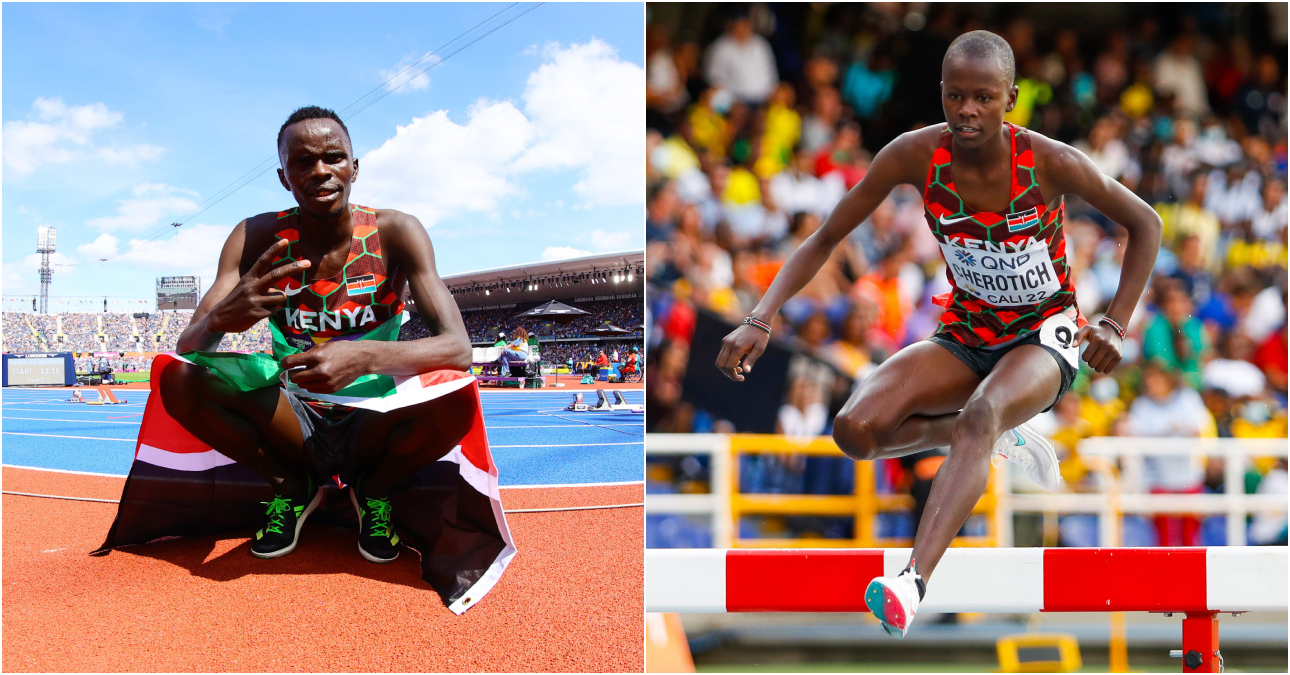
In the 3,000 m steeplechase, Faith Cherotich reminded the athletics world that Kenya remains the home of the steeplechase.
The 21-year-old contributed to the golden haul with a fearless performance in the 3,000m steeplechase, storming to victory in a Championship Record of 8:51.59 beating Winfred Yavi of Bahrain- the 2023 world champ and 2024 Olympic champ- by nearly five seconds.
This was ‘Little Faith’s’ first global gold after earning the bronze in 2023 and 2024. The championship record came despite the fact that race was run in warm and muggy conditions – 83 degrees, 76 dew point at start.
Emmanuel Wanyonyi – Men’s 800m star
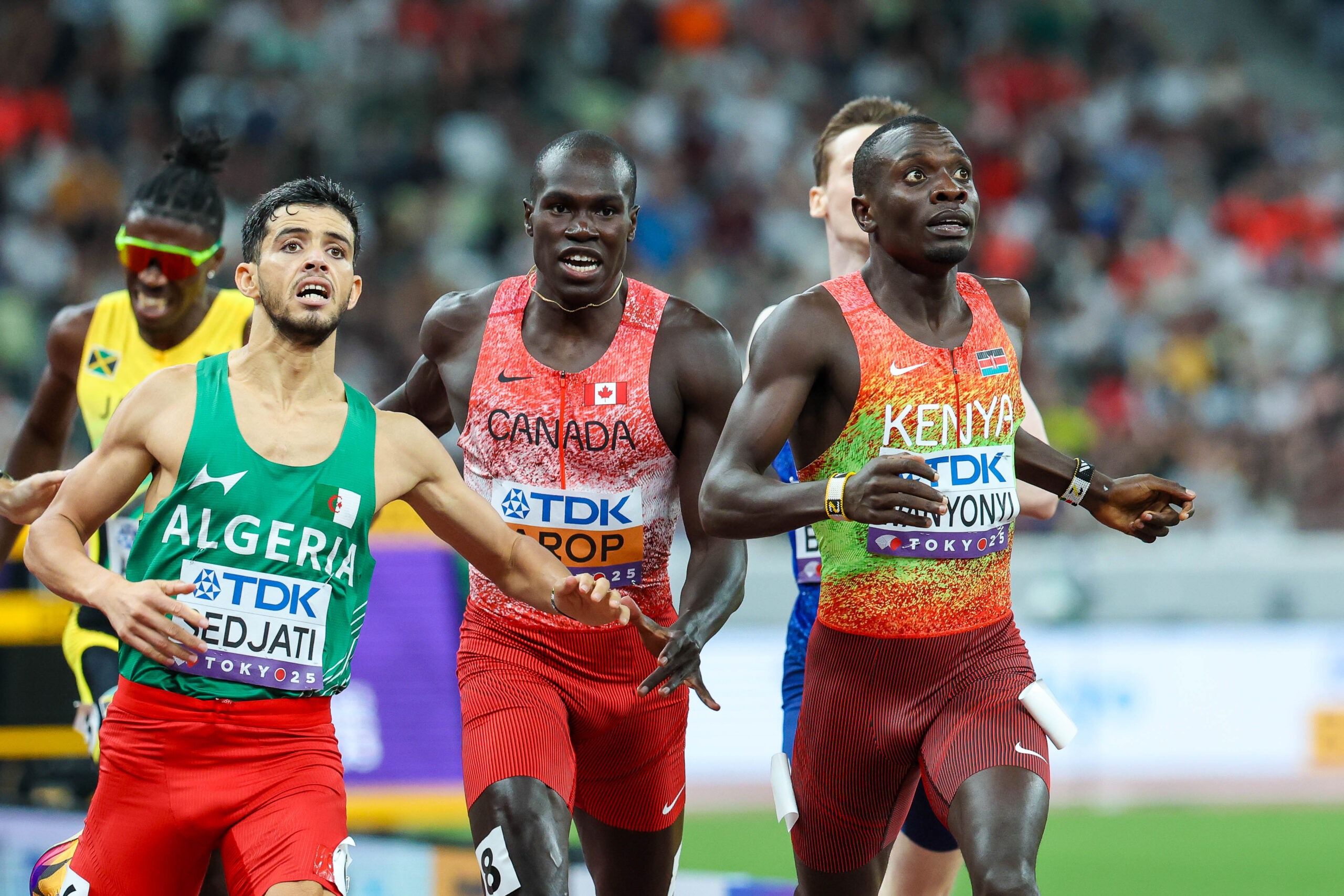
Kenya’s Emmanuel Wanyonyi battles off Marco Arop and Jamel Sedjati on his way to men’s 800m gold. Photo Courtesy/ AK/KELLY AYODI
On the men’s side, Emmanuel Wanyonyi stood head-and-shoulders as Kenya’s top global performer in 2025.
In Tokyo, Wanyonyi in a brave show led from gun to triumph in a Championship Record time of one minute and 41.86 seconds holding off the charging Sedjati Djamel of Algeria who settled for silver in a season best of 1:41.90.
Wanyonyi now joins Rudisha and Korir as the only athletes to hold both the World and Olympic 800m title concurrently.
His performance underscored Kenya’s resurgence in the 800 m, an event that has become increasingly competitive globally. Although Kenya dominated many women’s events, Wanyonyi was the sole Kenyan male gold-medalist in Tokyo — underscoring his exceptional output.
To top an exceptionally season, the 21-year-old has earned himself a a nomination for the 2025 Men’s Track Athlete of the Year by World Athletics.
Others who stood-out in the season with records are Ferdinand Omanyala who proved that Kenyan sprinters can also make headlines. At the 2025 Adidas Atlanta City Games he ran a 150m time of 14.70 s, setting an African record in that seldom-raced distance.
On the road marathon circuit, Kenyan excellence remained front and center — Sharon Lokedi delivered one of the standout performances. At the 2025 Boston Marathon she won the women’s title in 2:17:22, setting a new course record.
The 2025 season will be remembered for record breaking, depth and sweeps, versatility and big-stage delivery.
As Kenyans celebrate their victory at the just-concluded World Athletics Championships in Tokyo, the country must also pause to reflect on a growing concern, the dwindling fortunes of the ‘boy-child’ in athletics. Kenya returned home with 11 medals; seven gold, two silver and two bronze, finishing second behind the USA’s dominant haul of 26 medals.
But beneath the celebrations lies a sobering reality. Of Kenya’s medalists in Tokyo, women carried the bulk of the glory, securing six golds and two silvers, while their male counterparts could only muster one gold and two bronzes.
But all is not lost.
When Emmanuel Wanyonyi crossed the finish line first in the men’s 800m at the 2025 Tokyo World Athletics Championships, pumping his fists and roaring with joy, it was more than just another gold medal for Kenya — it was a sigh of relief.
For the first time since Emmanuel Korir in 2022 at the Eugene World Championships, Kenya had a male 800m champion standing atop the podium. In a championship dominated by Kenyan women, Wanyonyi’s performance was a powerful reminder: the kings of Kenyan track might just be coming back.
A Glimmer in the Storm
The Tokyo 2025 Championships were tough for Kenya’s male athletes. Out of the seven gold medals Kenya took home, only one came from a man — Wanyonyi’s. The women swept everything else from 800m through marathon, leaving the men in a shadow of their own history.
For a nation that once ruled the 800m, 1500m, and the steeplechase, it felt like watching a giant trying to find its footing again. Wanyonyi’s victory, however, was a crucial reminder that the foundation isn’t gone — it just needs rebuilding.
The 21-year-old has been the only standout male athlete over the last three years winning a silver at the Budapest23 World Champs, an Olympic gold at Paris24 and the latest gold in Tokyo. Wanyonyi has shown maturity far beyond his age. His Tokyo win was not only about strength but race intelligence — the ability to pace, position, and close out perfectly. Traits that David Rudisha mastered a decade ago.
Since his senior debut at the worlds in Eugene 2022, Wanyonyi has made huge strides. It’s not just about amassing titles. Wanyonyi has also proven he can run very fast.
He achieved the second-fastest time in the 800m, 1:41.11, which is just 0.20 seconds shy of Rudisha’s world record.
“Running the fast time so soon after the Olympics was a surprise for me,” he recalled of his Lausanne race, where he closed in on Rudisha’s iconic 1:40.91 mark from London Olympics 2012.
From Rudisha to Wanyonyi: The Changing of the Guard
When Rudisha, Wanyonyi’s mentor broke the world record — running a near-perfect solo race — he redefined the event. For years, Kenya was unbeatable in the two-lap race. But since Rudisha’s injuries and retirement, the men’s 800m crown had slipped through Kenyan fingers until Korir won the delayed 2020 Tokyo Olympics held in 2021.
Wanyonyi’s gold in Tokyo wasn’t just a medal; it was closure for a country that was losing hope of dominating the two-lap race with competition coming from Canada’s Marco Arop and Algeria’s Djamel Sedjati.
“After Rudisha, it was like we were searching for identity,” said Barnaba Korir, Athletics Kenya’s performance director. “Now with Wanyonyi, Simon Koech, and Reynold Cheruiyot coming up, we’re seeing a generation that blends natural talent with modern preparation.”
Indeed, Wanyonyi trains under a new model that emphasizes recovery, pacing science, and tactical rehearsal — areas that Kenya’s older systems often overlooked. His camp in Kapsabet, guided by emerging coaches, uses GPS-based tracking and nutrition monitoring.
Wanyonyi now joins Rudisha and Korir as the only athletes to hold both the World and Olympic 800m title concurrently.
“Wanyonyi is now the second-fastest and it’s just a matter of time if he keeps on pushing and doing the right thing, good training,” said Rudisha on his mentee’s threatening his record that has stood for more the 13 years.
The Young Guns
Wanyonyi is not alone. A small but growing group of young male athletes is emerging, eager to reclaim Kenya’s dominance on the track.
Reynold Cheruiyot, the 2023 World u-20 champion and 2025 World Championships bronze medalist, is being touted as the future of the 1500m — a space once ruled by Timothy Cheruiyot and Asbel Kiprop.
KENYA’s Reynold Cheruiyot (C)scoops bronze in men’s 1500m at Tokyo World Champs; Portugal’s Nader wins gold, Briton Wightman takes silver. Photo Courtesy/SUPERSPORT
The 21 year-old claimed his bronze medal in a time of 3:34.25. The race was won by former Moroccan now trading for Portugal, Isaac Nader in a nail-biting finish in a time of 3:34.10.
Another emerging talent is Edmund Serem a steeplechase bronze medalist in Tokyo. Serem, 17, finished third with a time of 8:34.56. He followed New Zealand’s Geordie Beamish, who staged a dramatic sprint finish to snatch gold in 8:33.88, ending Soufiane El Bakkali’s reign of dominance as the Moroccan took silver in a closely contested race.
The 2024 World u-20 champion credited his success to the inspiration he received from his mentor and legendary marathon runner Eliud Kipchoge.
“I was anxious because of the massive crowd in the stadium, as well as running alongside the world beaters, but I maintained my composure. I drew my encouragement from my mentor,” said Serem the younger brother to Amos Serem– the 2021 world U20 champion.
World u-20 steeplechase champion Edmund Serem. Photo Courtesy/ World Athletics
Simon Koech, meanwhile, is also in the discussions to lead Kenya back to its glory days. He says the emerging crop of talent in the discipline fills him with hope that Kenya will roar once again.
“If you look at the new talents that are emerging such as Serem, you can tell that we will reclaim our dominance in the men’s 3000m steeplechase. They have spiced up the competition in the local scene with those of us who have been in the game for sometime. That can only increase the quality of athletes that go on to represent the country at international competitions,” the 2021 World u-20 bronze medalist.
Kenya has struggled in the water-jump-and-hurdles race in the past five years, having relinquished the Olympic title to Moroccan Soufiane El Bakkali. Bakkali has gone on to become a thorn in the flesh of Kenya, maintaining a tight grip on a race that has been a preserve of the East Africans since Amos Biwott won gold at the 1968 Olympics in Mexico City.
“These young men are learning from the women,” noted coach Bernard Ouma, speaking during a post-championship analysis show on NTV. “They’ve seen how Faith [Kipyegon] and Mary Moraa train — the discipline, the structure, the professionalism. They’re beginning to apply that.”
Learning from the Queens
There’s no denying it: Kenyan women are currently setting the standard. Wanyonyi and his peers have openly admitted that watching Faith Kipyegon, Beatrice Chebet, and Peres Jepchirchir dominate the global stage has been a source of motivation.
“If you look at how Faith prepares, you realize success is not just talent,” Wanyonyi said in an interview with BBC Sport Africa after Tokyo. “She trains like a machine, she plans her season perfectly, and she never loses focus. That’s what I’m trying to learn.”
Sports analyst Martin Keino, son of Kipchoge Keino, believes this cross-gender inspiration is healthy.
“Kenya’s women have raised the bar. The men now know they can’t just rely on history. Wanyonyi’s win shows the boys are watching — and catching up,” he said during a KBC Sports Review segment.
The Road Ahead
For Kenya’s men, the challenge is clear — rebuild the track empire one step at a time. The 2026 Commonwealth Games and the 2027 World Championships offer the perfect stages.
Wanyonyi’s Tokyo gold, Cheruiyot’s and Serem’s (bronze) may have been a light in a dark tunnel, but it could mark the beginning of Kenya’s men’s renaissance.
In many ways, Wanyonyi’s rise mirrors Kenya’s athletic story — humble beginnings, explosive talent, and a relentless belief in redemption.
As Rudisha himself tweeted after the Tokyo final: “A new champion, same spirit. Kenya’s men are back.”
For now, Kenya’s women may hold the crown, but the men are gathering their forces again. And if Wanyonyi’s confident smile and golden finish are anything to go by — the kings are not gone. They’re simply preparing for a royal comeback.
The way forward
The allure of more money in road running is pricing away athletes at a tender age, posing the greatest threat to the East African powerhouse in losing its dominance in men’s races on the track. As veteran coach Julius Kirwa suggest, Kenya must address the issue of young male runners going to the road: “It is very difficult for an athlete to compete well at the track after going to the road. We are trying to address this problem with the Federation and we are talking to young athletes from the grassroots, just to ensure they understand the progression of going to the road.”
Secondly, we must be patient and nurture the new crop of runners and also use these young athletes and the legendary ones to motivate the hopefuls.
For example, Wanyonyi is never ashamed to talk about his late start in running start or previous personal struggles: “I know I motivate so many people because when they look at where I was and where I am now, they know anything is possible,” he reflected in an exclusive interview with Olympics.com.
Former javelin world champion Julius Yego, who captained the Tokyo squad, believes men’s disciplines are in transition. “We left it too late, and to get back on track will take time,” he said pointing to the collapse of the steeplechase dynasty, once Kenya’s fortress.
“We over-relied on the likes of Kemboi, Brimin Kipruto, and Paul Kipsiele and forgot to groom replacements,” he admitted.
Still, he insisted Edmund Serem’s bronze was a breakthrough to build on: “It is a good start. We should take advantage and build a team around Edmund.”
But Yego also challenged male athletes to take responsibility saying ‘most lack patience’. For him, success comes from sacrifice and resilience, not shortcuts.
“When things don’t work, they jump off. I’ve been around since 2007, and it hasn’t been smooth. Between 2007 and 2010, it was very difficult, but I soldiered on,” he said.
Thirdly, Kenyans should not turn the current crisis into a gender war. In Beijing 2015, Kenya won seven golds, and five were men’s. Nobody complained then. Now that the women are shining, we must not blame the boy-child but work to lift him. Kenyans should be part of the solution by applauding the wins and the positives rather than criticizing everything.
Lastly, the federation should organize more invitational meets for sprinters where the athletes can measure themselves against continental sprinting powerhouses. Ferdinand Omanyala has lit the spirit of sprinting and more young males want to run in the short races.
National sprints’ coach Stephen Mwaniki stresses the urgent need to sharpen the country’s sprinters through greater exposure and longer training camps to build team chemistry.
“We need more exposure for our sprinters so they can learn to compete and excel on the big stage. Competing against countries like Botswana and South Africa in invitational events will give us the edge we currently lack,” Mwaniki explained.
He also emphasized the importance of longer, structured training camps to sharpen technical areas, especially in relays.
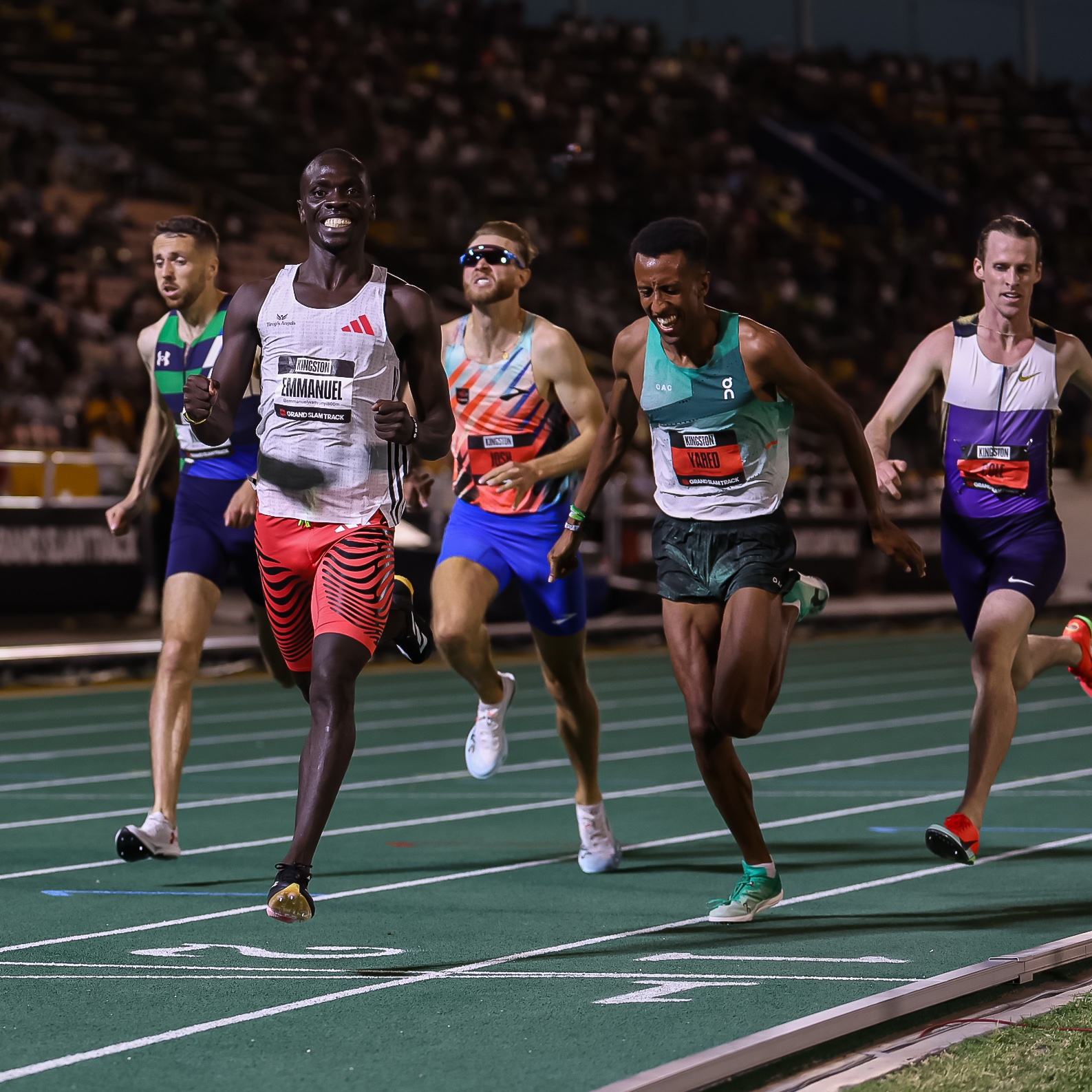
Kenyan star Emmanuel Wanyonyi tore up the script to surprise the field in the men’s 1500mrace at the inaugural Kingston Grand Slam Track Meeting, on Saturday at the Independence Park National Stadium, Jamaica.. Wanyonyi, the Olympic 800m champion, sprinted down the home straight and no one could live with his pace as he crossed the line in a lifetime best of 3:35.18.
The 20 year-old who was making his international debut over the distance took down some big scalps, including the US duo of Yared Naguse, the Olympic bronze medalist, who clinched second in 3:35.36 and Olympic champion Cole Hocker, who finished third in 3:35.52. World champion Josh Kerr was fifth in 3:35.61.
“Everything is good because this is my future race – the 1500m,” said Wanyonyi the 2023 World 800m silver medalist. “I need to bring this event home and also set a new PB in the 1,500m race.”
However, before he transitions into the three-and-three-quarter laps race, Wanyonyi aims for a new personal best in his specialty- the 800m race. “I need to run a PB in the two-lap race this year before thinking of the 1,500m. Even my coach says I need to set an 800m PB in 2025.”
For context, Wanyonyi is already at 1:41.11- the number three on the all time fastest runners in the race. He is 0.20s away from David Rudisha’s world record of 1:40.91. Wanyonyi’s time ties him with Wilson Kipketer.
Ever since he mad his debut in the 800m race at the World Under 20 Championships in Nairobi in 2021, Wanyonyi has established himself as one of the giants in the two-laps race with his final kick. He has even been dupped ‘the new Rudisha’.
On the second night of the Jamaican series, four champions – Matthew Hudson-Smith, Gabby Thomas, Kenny Bednarek and Diribe Welteji.
Kenny Bednarek, having conquered the 100m field the previous evening, was more at ease competing in his specialty, the 200m, in the ‘short sprint’ category. The two-time Olympic silver medalist ran a blinding curve, which gave him a comfortable lead entering the straight. He pulled away even further to burst the tape in 20.07 (+0.2m/s). Britain’s Zharnel Hughes was runner-up in a season’s best of 20.37, which saw him finish second overall in the men’s short sprint category.
Great Britain’s Hudson-Smith ran a storming home straight to overhaul Trinidadian Jereem Richards a few meters from the finish line to take the 200m in the men’s ‘long sprint’ category and US$100,000 prize money in 20.77 (-3.3m/s).
“The 200m is my baby, that’s how I originally came up in the sport,” said Hudson-Smith, who was making his second visit to Jamaica. “This is what I needed. I came here to execute and race against the best in the world. We don’t have many opportunities to race each other because many people duck, but Grand Slam Track forces you to be here, and that’s what will help you later in the season.”
Diribe Weltiji, who finished a close second in the 800m on Friday, made no mistake in the 1500m as she completed an authoritative win in 4:04.51. The victory ensured the Ethiopian supplanted 800m winner Nikki Hiltz in the overall ‘short distance’ standings with 20 points and collected the US$100K top prize. Hiltz, who needed to finish in the top two to earn at least a share of the top prize money, crossed the line third in 4:05.39, amassing 18 points overall.
Salwa Eid Naser of Bahrain produced the individual performance of the meet so far when she stunned a quality field to take the women’s 400m in a world-leading 48.67. Naser, who opened her season last week with a 48.94 run in Bayaguane, stepped on the accelerator from the gun and only slowed after crossing the line.
USA’s Gabby Thomas followed in Naser’s wake to run a PB of 49.14 and, more importantly, pocketed the overall US$100K top prize after accumulating 20 points over two events, with Naser finishing second overall with 17 points. “After yesterday’s race, I was so mad with myself because I knew I could do better,” said an awestruck Naser. “Coming out here and running this time, I feel fulfilled for yesterday.”
The inaugural Grand Slam Track series, organized by four-time Olympic gold medalist Michael Johnson, got off to a glittering start in at the Independence Park National Stadium, Kingston on Friday as many of the world’s leading athletes descended on Jamaica’s capital to take part in the lucrative series.
Big guns starred in the series opener with the likes of World and Olympic champion Sydney McLaughlin-Levrone, Nikki Hilt, Gabby Thomas, Kenny Bednarek, and Grant Fischer all dominating and winning their respective events.
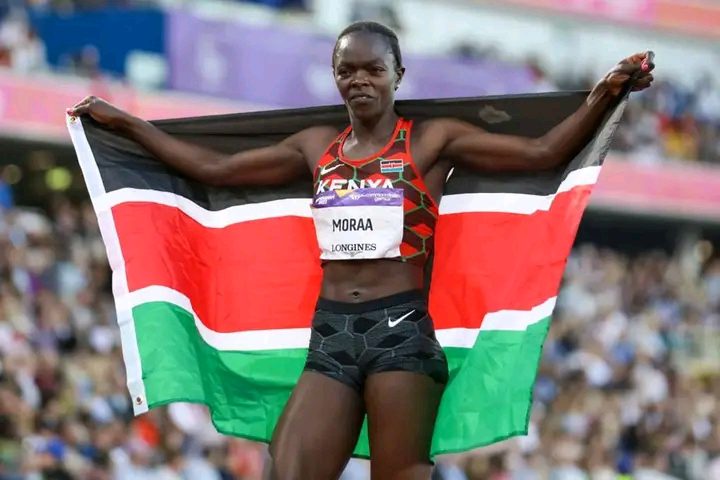
However, it was a bad day in office for the Kenyan contingent led by Olympic 800m bronze medalist Mary Moraa and World 10km record holder Agnes Ngetich as they faltered in their respective races. Moraa, the 2023 World champion performed dismally when as finished a distance eighth position in a time of 2:00.97 in the women’s 800m race.
In an event that saw six women dip under two minutes, USA’s Nikki Hilt (1:58.23) outsprinted Ethiopia’s Diribe Welteji (1:58.29) to claim the victory. Australia’s Jessica Hull was third in a personal best of 1:58.58. Another Kenyan in the race, Susan Ejore, finished fifth after timing 1:59.26.
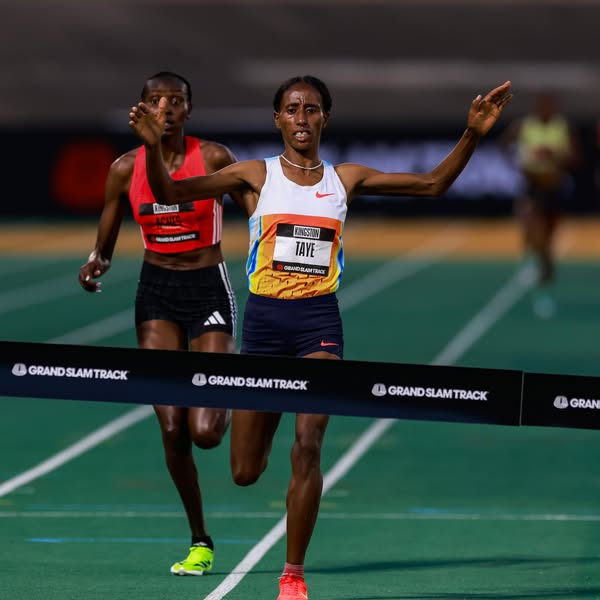
Ngetich on the other hand, opened her season with a second place finish in the women’s 3,000m race behind the 2023 World 10,000m bronze medallist, Ejgayehu Taye of Ethiopia. Taye outpaced the Kenyan in the last 300m and held on to cut the tape first in 8:28.42 with the latter coming home in second place in a new personal best of 8:28.75.
The 2018 World Junior 3000m bronze medalist, Tsigie Gebreselama of Ethiopia finished in third with Kenya’s Hellen Ekalale Lobun coming home in fourth place.
Taye’s winning time was the fastest time ever recorded in the Caribbean.
McLaughlin-Levrone opened her season with a comfortable win in the women’s 400m hurdles, bursting the tape in a world-leading 52.76. Former world-record holder and 2016 Olympic champion Dalilah Muhammad finished a distant second in 54.59. In the men’s equivalent, Olympic bronze medalist Alison dos Santos outclassed the field to register a world-leading 47.61.
Gabby Thomas powered away from the field in the women’s 200m to win in 22.62. World and Olympic 400m champion Marileidy Paulino finished strong to snatch second in a season’s best of 22.93.
Double Olympic medalist Grant Fisher led a US sweep in the men’s 5000m, crossing the line in 14:39.14 ahead of Cooper Teare (14:39.31) and Dylan Jacobs (14:39.56). Kenya’s Ronald Kwemoi, the Olympic 5000m silver medalist came fifth clocking 14:40.64.
The men’s 100m closed the show with US sprinter Kenny Bednarek, who was making his first appearance on Jamaican soil, tasting victory in 10.07. Bednarek, running in a strong headwind (-1.3m/s), timed his run to perfection to deny hometown favorite Oblique Seville (10.08).
The highly anticipated fourth leg of the AK Track and Field Weekend Meet is set to take place at Afraha Stadium in Nakuru County on 4-5 April. Action returns to this stadium after a four-year hiatus to allow its renovation.
This weekend’s actin could serve as a test to the national and Nakuru county governments to accelerate the completion of the 77-years-old stadium.
This event promises to be a thrilling spectacle, with Olympic steeplechase bronze medalists Faith Cherotich and Abraham Kibiwott being the main attractions.
The meet will feature a diverse range of track and field disciplines, drawing top athletes from across the country as they prepare for upcoming international competitions, including the World Championships and the Paris 2025 Olympics qualifiers.
Key Competitors and Events
Faith Cherotich, an Olympic bronze medalist in the steeplechase, will compete in the 3000m steeplechase event at the upcoming AK Track and Field Weekend Meet. Abraham Kibiwott, another Olympic bronze medalist, is set to participate in the 5000m race.
Vincent Keter will showcase his talent in both the 800m and 1500m events, while Elkana Chemilil is entered for the 400m race. Kevin Kipkorir will compete in the sprint events, including the 100m and 200m races. Obadia Kipleting will join Vincent Keter in the 1500m event. Lona Cherono is slated to run in the 5000m race, alongside Cornelius Kemboi. Noah Kibet will also participate in both the 800m and 1500m events.
Hezbon Ochieng is registered for the 100m sprint, while Leonard Bett will compete in the 3000m steeplechase alongside Faith Cherotich. Kyumbe Munguti is set to run in the 1500m event. Lucia Williams from South Sudan will represent her country in the 100m sprint. Arron Cheminigwa and Sarah Moraa are both scheduled to compete in the 800m race.
Detail of the highly anticipated event
Bib collection for participants is currently underway at Afraha Stadium, with athletes required to collect their numbers on April 3 between 9:00 AM and 6:00 PM. The event marks a significant milestone for Afraha Stadium, which has undergone extensive renovations, including the installation of a modern blue tartan track, replacing the old dusty murram surface
The AK Track and Field Weekend Meet is part of Kenya’s efforts to nurture athletics talent at the grassroots level, providing a platform for young athletes to compete alongside seasoned runners. Winners in each category will receive attractive cash prizes, with first-place finishers earning Ksh. 20,000, second place Ksh. 15,000, and third place Ksh. 10,000.
Despite the challenges the inaugural 2025 Grand Slam Track Series poses, World 800m champion Mary Moraa is determined to achieve a back-to-back 800m world title. The 2025 World Championships are slated for 13-21 September in Tokyo, Japan, and if successful Moraa will become the third woman to achieve the feat.
The other two to have back-to-back world titles at the distance are South Africa’s Caster Semenya who won in Berlin 2009 and Daegu 2011, and Mara Mutola of Mozambique who defended her title in Saint-Denis 2003 afer triumphing in Edmonton 2001.
Moraa, the national record holder, has signed up for both the 800m and 1,500m races which kick-of f this Friday at Independence Park Kingston, Jamaica.
Spearheaded by retired American sprinter Michael Johnson, the high-stakes series offers a potential payout of Sh52million for athletes who win all the four Slams in their respective categories. Each Slam winner in each category will cash in Sh13million.
Moraa’s coach Alex Sang revealed that she will only participate in select Diamond League events to allow her sharpen her skills ready for the final.
“Our plan is to balance the Grand Slam and the Diamond League,” said Sang as per NationSport adding that Moraa will for the first time will skip the Kip Keino Classic scheduled for 31 May.
The 1:56.03 runner will face competition from Ethiopia’s Diribe Welteji- who is fresh from winning silver medal at the World Indoor Championships in Nanjing, China, Nikki Hiltz (USA), and Australia’s Jessica Hull.
Kamworor targets new Person Best in Netherlands
Two-time New York Marathon champion Geoffrey Kamworor is hoping to shatter his personal best in his first 42km outing of the year at the Rotterdam Marathon on 13 April.
Kamworor currently holds a personal best of 2:04:23 set during the 2023 London Marathon, where he finished second just behind the world record holder, the late Kelvin Kiptum.
The 32-year-old is eyeing an even faster time on one of the fastest courses in Europe.
“I’m coming to Rotterdam to break my personal best,” Kamworor shared through his training camp, NN Running Team.
The flat, record-friendly streets of Rotterdam have witnessed some of the fastest times in marathon history. Belgium’s Bashir Abdi holds the course record of 2:03:36, set in 2021 and came close to that mark again in 2023 with a 2:03:47 finish.
The Dutch city also boasts two former world records, courtesy of Portugal’s Carlos Lopes (2:07:12 in 1985) and Ethiopia’s Belayneh Dinsamo (2:06:50 in 1988).
Kamworor enters Rotterdam fresh off a 58:44 second-place finish at the Barcelona Half Marathon on 16 February, where Uganda’s Jacob Kiplimo stole the show with a stunning world record of 56:42.
The 2015 world 10,000m silver medalist is eager to bounce back from a disappointing 2024 season that saw him miss out on the podium at the New York Marathon, finishing fifth in 2:08:50 in a race won by Netherlands’ Abdi Nageeye (2:07:39). Evans Chebet (2:07:45) and Albert Korir (2:08:00) completed the podium in that race.
Two-day sprints and relay trails in readiness for Guangzhou
Athletics Kenya will hold special relay trials on 11-12 April as the country races against time to secure slots at the World Athletics Relays set for 10-11 May in Guangzhou, China.
Only the top 16 nations will secure qualification for the World Relay Championships, a crucial step ahead of the Tokyo World Championships later in September.
So far, only the mixed 4x400m relay team has secured qualification for the Championships in Guangzhou, China.
National sprints coach Stephen Mwaniki has revealed that the two-day selection event will exclusively focus on the men’s and women’s 4x100m and 4x400m relay teams, ensuring they meet the 13 April qualification deadline.
“Our main focus will be pushing the men’s and women’s 4x100m as well as the 4x400m for both men and women to secure qualification for China,” Mwaniki noted.
The men’s 4x100m is currently ranked 18 with a time of 38.61 set at the Nyayo Stadium last year while the 4x400m team is ranked 19th with a 3:02.34 time set in Douala, Cameroon. Meanwhile, the women’s teams are ranked 54th in the 4x100m and 29th in 4x400m.
The 4x400m mixed relay squad is already within the qualification bracket, ranked 10th with a time of 3:11.43 set last year at the Nyayo Stadium.
Mwaniki noted that having already secured qualification, they will not emphasize the mixed relay saying, “we will not be so keen on the 4x400m mixed.” However trials will be conducted to beef up the team.
The trials will feature a two-day competitive structure and will be by invitation, ensuring only top contenders compete for slots. The first day will see individual sprints in the 100m, 200m and 400m with selectors analyzing performances before forming relay teams for competition on the second day.
For the times to be World Athletics-approved, Kenya will have to compete against regional teams to boost competition.
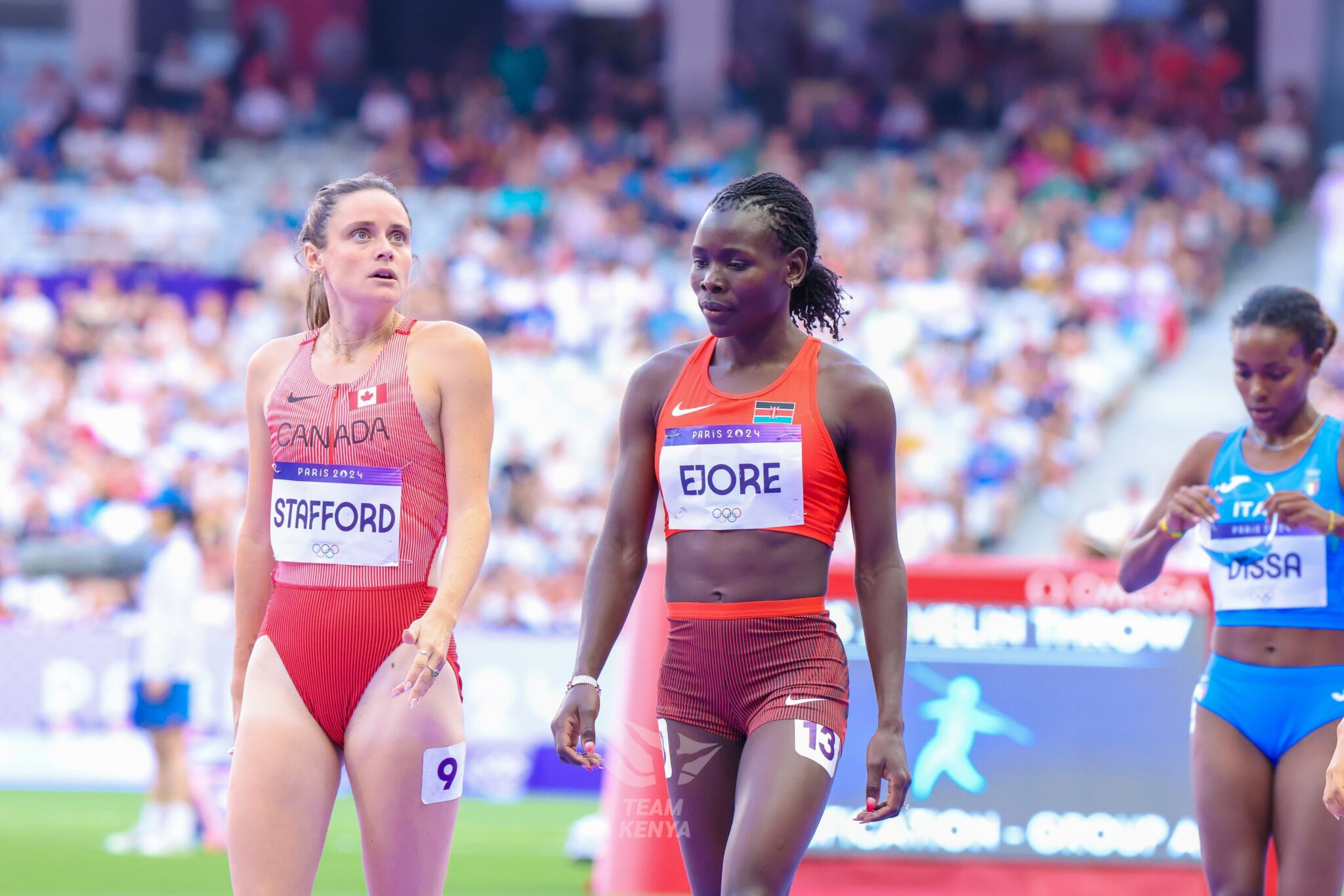
It was a show of class, but not for Kenyan stars at the just concluded World Indoor Championships in Nanjing, China. The Kenyan contingent comprising of five men and women apiece failed to clinch any medal with the best result being Susan Ejore reaching the 1,500m final where she finished fifth.
Last year’s indoor champs in Glasgow was something to be proud of if compared to Nanjing25 as Kenya bagged a 3.000m bronze medal thanks to the women’s 3,000m steeplechase record holder Beatrice Chepkoech.
Kenya’s struggles at the indoor championships stem from lack of proper training facilities, poor preparations, and limited exposure to indoor racing.
“The indoor track is very different from what we use outdoors. It demands specific training, especially for athletes competing in an indoor setting for the first time,” said Athletics Kenya (AK) Youth Development Chair Barnaba Korir. “You can’t compare the performance of Americans and other European countries because they have the infrastructure necessary for them to do well.”
He further noted that Ethiopian athletes have proper experience running Indoors as compared to Kenyans: “Ethiopian athletes also are regulars in the Indoors circuits and they feature in races in Europe.”
Ethiopia, Kenya’s biggest rival in distance running, reaffirmed its status as Africa’s indoor powerhouse, ranking third overall with five medals (two gold and three silver). The United States dominated the championships with 16 medals (six gold, four silver, six bronze), followed by Norway with four (three gold, one bronze).
Kenya’s team coach Vincent Mumo said they did not have adequate time to prepare the athletes: “We had little time to prepare the athletes, but we tried to use it adequately to make the team compete effectively.”
Echoing Korir’s sentiments, Mumo noted that Ejore secured a finals slot, owing to the proper facilities she uses while training in the USA.
“Ejore has experience in running the Indoor circuit in the US, where there are proper facilities. So she was in a better position to secure a slot in the finals, unlike the other athletes,” Mumo said.
Team manager Abdullahi Omar echoed the concerns, highlighting the limited exposure to indoor racing.
“Considering Kenya rarely competes indoors, I believe the team did well. This was not the performance we expected, but given the circumstances, it was commendable,” Omar noted.
The Nanjing25 showpiece marked the start of a busy year for the sport. Three World Athletics Series events will be held this year, all of them in Asia. After the World Indoor Championships in Nanjing, Guangzhou will host the World Athletics Relays in May and then the World Athletics Championships will take place in Tokyo in September.
Final figures from Nanjing confirm that 516 athletes participated, comprising 274 men and 242 women. A total of 117 federations across all six continental areas took part in a championships where 32 federation records, three area records, one championship record and three world-leading marks were set.
There were several history makers in Nanjing. Ethiopia’s Gudaf Tsegay broke the championship record to take the women’s 1500m title in 3:54.86, a mark that no other athlete in history has ever bettered indoors.
US sprint hurdler Grant Holloway and Swedish pole vaulter Mondo Duplantis became the first men in their respective disciplines to win three successive world indoor titles. Jakob Ingebrigtsen became just the second man in history to win two individual gold medals at a single World Indoor Championships, taking the 1500m and 3000m titles.
World Athletics has approved the introduction of mandatory cheek swabbing to determine an athlete’s gender, with the organization’s president Sebastian Coe saying the decision was taken to “doggedly” protect the female category.
It is understood World Athletics’ intention is to have the testing in place for athletes wanting to compete in the female category at the World Championships in Tokyo from 13-21 September.
Coe said on Tuesday: “It’s important to do it because it maintains everything that we’ve been talking about, and particularly recently about not just talking about the integrity of female women’s sport but actually guaranteeing it.
“We feel this is a really important way of providing confidence and maintaining that absolute focus on the integrity of competition.
“Overwhelmingly the view has come back that this is absolutely the way to go, within the caveats raised (on testing not being too intrusive),” added Coe, after World Athletics conducted consultation on the proposal earlier this year.
Coe will do ‘whatever is necessary’ to safeguard female category
The consultation document stated: “The childhood or pre-pubertal performance gap in the sport of athletics specifically is three to five per cent in running events and higher in throwing and jumping events.”
Coe added the consultation was “widely held” and “exhaustive” and had received feedback from over 70 individual groups.
Asked whether he felt the policy would stand up to legal challenge, he said: “Yes I am, but you accept the fact that that is the world we live in.
“I would never have set off down this path to protect the female category in sport if I’d been anything other than prepared to take the challenge head on.
“We’ve been to the Court of Arbitration on our DSD (difference of sexual development) regulations. They have been upheld and they have again been upheld after appeal.
“So we will doggedly protect the female category and we’ll do whatever is necessary to do it.”
What will the test entail?
A World Athletics working group said in February that the required test will be for the SRY gene and, if required, testosterone levels.
This will be taken via cheek swab with any necessary follow-up via dry blood spot analysis.
The SRY gene is almost always on the Y chromosome, which plays a crucial role in determining male sex characteristics.
The working group said there was now evidence that testosterone suppression in DSD and transgender athletes could only ever partly mitigate the overall male advantage in the sport of athletics.
IOC president-elect Coventry not ruling out sex testing
Newly-elected International Olympic Committee president Kirsty Coventry, who beat Coe to that role last week, told Sky News after her appointment that she was not ruling out sex testing, saying: “This is a conversation that’s happened and the international federations have taken a far greater lead in this conversation.
“We know in equestrian sex is really not an issue, but in other sports it is.
“So what I’d like to do again is bring the international federations together and sit down and try and come up with a collective way forward for all of us to move.”
The IOC introduced “certificates of femininity” at the 1968 Mexico Olympics but those chromosome-based tests were deemed unscientific and unethical and dropped ahead of the Sydney Games in 2000.
Reem Alsalem, the UN’s special rapporteur on violence against women and girls, last year called on the IOC to reintroduce sex testing for female athletes to protect them from injuries amid concerns about eligibility.
Sex testing would have had no impact on the boxing controversary during the Paris 2024 Olympics.
The 2019 African 5,000m champion Lilian Kasait and two-time Zwolle Half Marathon champion Isaiah Lasoi will spearhead Kenya’s charge at the Prague Half Marathon set for 5 April.
Race organizers are expecting fast times with the Kenyan duo leading the charge in the men’s and women’s events.
“The Prague Half Marathon course is known for its speed and ideal conditions for fast times. We are excited to welcome such talented athletes and look forward to an exciting race,” said Carlo Capalbo, the chairman of the RunCzech Organizing Committee.
The current course record for the Prague Half Marathon is 58:24 set by Sebastian Sawe during his triumph last year while the women’s mark stands at 1:04:52 set by Joyciline Jepkosgei in 2017.
Kasait is gradually transitioning to the Half Marathon and will be making her second appearance over the 21km distance after debuting at the Valencia Half Marathon last October.
In Valencia, she clocked 1:03:32, finishing behind World 10K record holder Agnes Ngetich (1:03:04) and Ethiopia’s Fotyen Tesfay (1:03:21).
Meanwhile, Charles Matata is set to defend his Venloop Half Marathon title on Sunday, as he returns to the streets of Venloop, Netherlands, aiming for back-to-back victories.
Matata claimed the title last year clocking 1:00:39 to lead an all-Kenyan podium finish with James Mutuku (1:01:36) and Raphael Kolian (1:01:42) second and third.
Matata is relatively new to the road races having made his debut at the New Delhi Half Marathon in 2023, where he clocked 1:00:05 for second place.
He trailed World 10,000m silver medalist Daniel Simiu (59:27) and was just ahead of Ethiopia’s Addisu Gobena (1:00:51).
His second appearance was in Madrid 2023, where he made the podium yet again, clocking 1:00:21 for second place behind Victor Kipruto (1:00:04).
However, Matata’s title defence is far from guaranteed, with compatriot Jorum Okombo, the 2024 Paris Half Marathon champion, posing a significant challenge.
Okombo is a seasoned campaigner over 21km with a string of podium finishes to his name.
His runners-up finish in Paris saw him clock 1:02:02— behind Bernard Kiprop (1:00:45) and ahead of Emmanuel Roudolff of France (1:02:11).
In 2017, he clocked 58:48 for a second-place finish in Copenhagen before going on to record another second-place finish in Venlo (1:00:20) the same year.
In 2018, he competed at the World Half Marathon in Valencia, Spain, finishing outside the top 10 in position 18 (1:01:34). Adding firepower to the men’s race are Evans Kipkorir and James Mutuku.